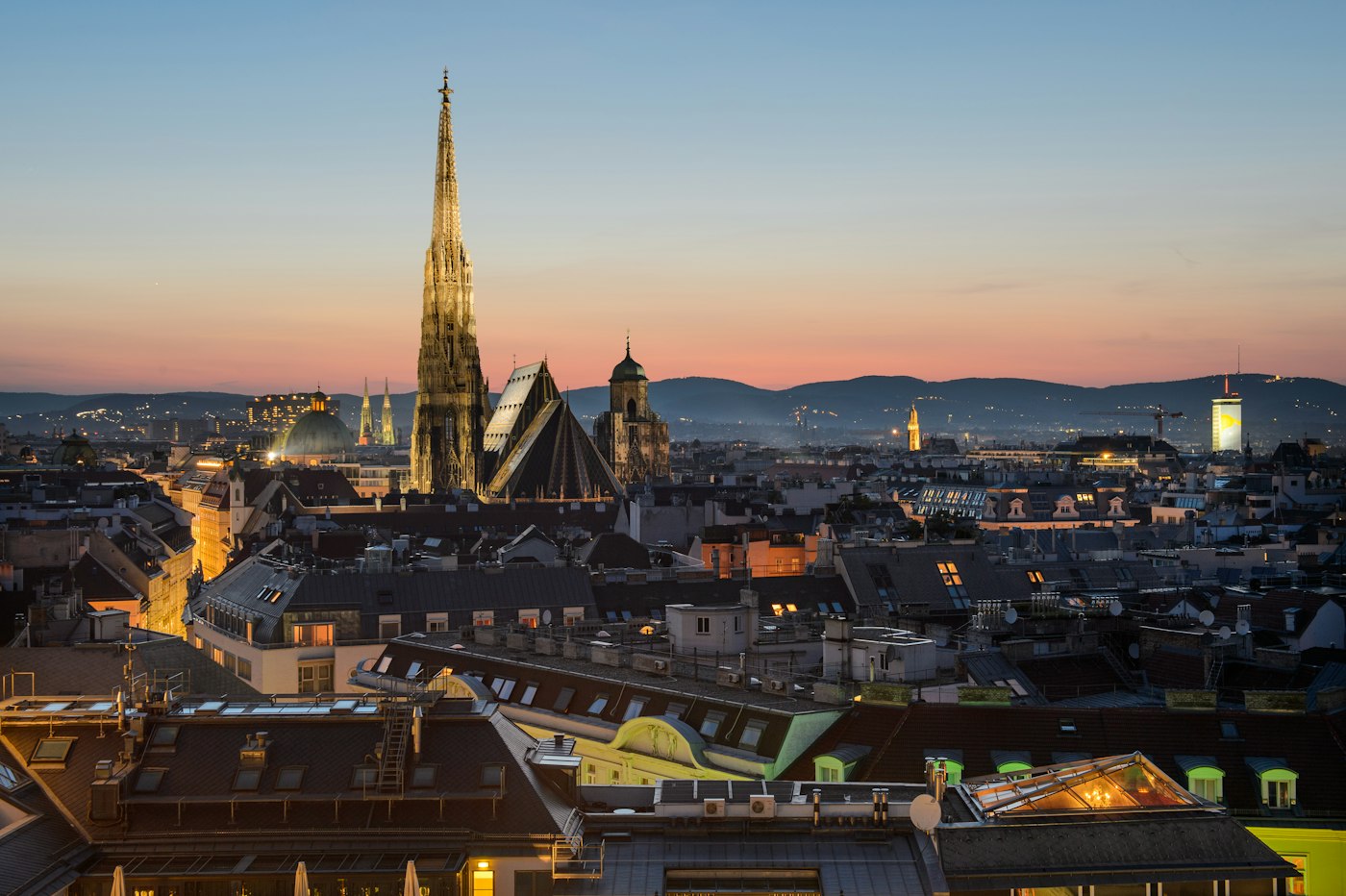
Austria is one of Europe's quietest success stories for Brazilian movers: high salaries, world-class public services, Vienna repeatedly ranked the most liveable city on Earth — and a structured, points-based immigration system that rewards qualifications, experience and German skills. The trade-off? Austrian bureaucracy is formal, deadlines are real, and almost everything runs in German. This guide walks you through the entire journey, from choosing the right Red-White-Red Card category in Brazil to buying groceries at Billa on your first Saturday (never on Sunday — everything is closed).
1. Which visa do you need?
As a Brazilian citizen you can enter Austria visa-free for up to 90 days in any 180-day period, but you cannot work on that entry and you cannot convert a tourist stay into a work permit from inside the country in most cases. For any move, you'll apply for a residence permit — usually a Rot-Weiß-Rot – Karte (Red-White-Red Card) — at the Austrian embassy in Brasília or the consulates in São Paulo or Rio de Janeiro before you fly.
Red-White-Red Card — Skilled Workers in Shortage Occupations
Most commonPoints-based permit for professions on Austria's shortage list (IT, engineering, nursing, skilled trades). You need a job offer plus enough points from qualifications, experience, language skills (German or English) and age. Valid 2 years, tied to your employer initially.
Red-White-Red Card — Very Highly Qualified Workers
No job offer neededIf you score enough points (advanced degree, senior experience, high previous salary, language skills), you can get a 6-month Job Seeker Visa to search for work in Austria, then convert to the RWR Card once hired.
EU Blue Card
High earnersFor university graduates with a job offer paying at least the annual gross salary threshold (roughly €51,500 in 2026 — verify the current figure). Simpler than the points system if your salary qualifies, and it eases mobility to other EU countries later.
Student Residence Permit
Study routeAdmission to an Austrian university (public tuition for non-EU students is around €727/semester — among Europe's cheapest) gets you a renewable permit. You may work up to 20 hours/week. After graduating, you can stay 12 months to seek a job and switch to an RWR Card for graduates.
Family Reunification (Familienzusammenführung)
Family routeSpouses and minor children of RWR Card / Blue Card holders get the RWR Card plus with free labour market access. Note: spouses of Austrian citizens usually must prove A1 German before arrival (family of RWR Card holders are exempt from the pre-arrival requirement).
RWR Card — Start-up Founders
EntrepreneursFor founders bringing an innovative product or service with at least €30,000 capital (half from own funds) and a credible business plan. Points awarded for education, experience, language and investment size. Vienna's startup scene is small but well-funded.
💡 Points calculator: The official migration.gv.at points calculator lets you score yourself before spending anything. German at A1 gives points; B1 or English at B2 gives more. Many Brazilians qualify through the "Skilled Workers in Shortage Occupations" list — check if your profession is on the current shortage list (updated yearly).
2. Documents to prepare in Brazil
Austrian authorities are strict about document formalities. Everything issued in Brazil needs an apostille (Apostila de Haia, done at any cartório authorized by CNJ) and a certified German translation — Austrian authorities generally want translations by a court-sworn translator (beeidigter Übersetzer). Start this 2–3 months before your application.
- Passport — valid at least 3 months beyond your intended stay; renew in Brazil if it expires within a year.
- Birth certificate (certidão de nascimento) — request a recent certified copy (inteiro teor is safest), apostille + sworn German translation.
- Marriage certificate — same treatment; needed for family reunification and tax class purposes.
- University diploma + transcript (histórico escolar) — apostilled and translated. For regulated professions (medicine, nursing, engineering, teaching), start the recognition process early via anabin-equivalent Austrian checks at ENIC NARIC Austria.
- Criminal record certificate — Certidão de Antecedentes Criminais from the Polícia Federal (issued online, free), apostilled + translated. Must be less than 3 months old at submission.
- Employment references — letters from Brazilian employers confirming role, dates and responsibilities (these earn points in the RWR matrix).
- Language certificates — ÖSD or Goethe-Institut for German (São Paulo, Rio, Porto Alegre, Curitiba and Salvador have Goethe centers); IELTS/TOEFL for English points.
- Proof of funds — recent bank statements; students need to show roughly €12,000/year.
- Passport photos — EU biometric standard (35×45mm), white background.
- Health insurance — travel insurance covering the first weeks until your Austrian insurance activates (see section 6).
⚠️ Translation trap: Translations done by Brazilian tradutores juramentados are sometimes rejected by Austrian authorities, who prefer translators sworn in Austria (list at gerichtsdolmetscher.at). Ask the consulate which they accept for your application — it can save you doing everything twice. IC360's apostille & translation guide covers the process step by step.
3. Your first 30 days in Austria — in the right order
Sequence matters enormously in Austria. The Meldezettel (address registration) is the key that unlocks everything else — you legally must register within 3 working days of moving into any accommodation, including a sublet or Airbnb for longer stays.
- Day 1–3: Meldezettel at the Meldeamt. Take your passport and the Meldezettel form signed by your landlord (Unterkunftgeber) to the local registration office (in Vienna: any Magistratisches Bezirksamt, or online via oesterreich.gv.at with ID Austria). Free if done within 3 days. You'll receive the Bestätigung der Meldung — guard it; every office asks for it.
- Week 1: Collect your residence permit card. If your RWR Card was approved via the embassy, you entered on a D visa and now pick up the card at the immigration authority (MA 35 in Vienna, Bezirkshauptmannschaft elsewhere). Fingerprints are taken; the card arrives in 2–3 weeks.
- Week 1–2: Open a bank account. With passport + Meldezettel you can open a Girokonto at Erste Bank (its "George" app is excellent and has English), Bank Austria, BAWAG or Raiffeisen. N26 and Revolut work in Austria and can bridge the gap before your Meldezettel exists.
- Week 2: Social insurance number (Sozialversicherungsnummer). Your employer registers you with ÖGK automatically on day one of your contract; the number arrives by post. Freelancers register themselves with SVS.
- Week 2–3: e-card. Austria's health insurance card is mailed automatically once you're registered with ÖGK. It doubles as your key to doctors, hospitals and e-prescriptions (see section 6).
- Week 3: Tax registration. Employees don't need to do anything — Lohnsteuer is withheld automatically. Get your FinanzOnline access (finanzonline.bmf.gv.at) anyway; you'll want it for the annual tax refund (Arbeitnehmerveranlagung), which returns money to most employees.
- Week 3–4: ID Austria. Austria's digital identity (successor to Handy-Signatur) lets you do almost all bureaucracy online. Register at any registration office or via the ID Austria page.
- Week 4: Transport pass. In Vienna, the annual Wiener Linien pass costs €365 — literally €1/day for all trams, buses and U-Bahn. Buy it at wienerlinien.at. The nationwide Klimaticket (~€1,300/year) covers all public transport in Austria.
✅ IC360 tip: Track every step with your personalised interactive Move Plan — it saves your progress and reminds you of Austria-specific deadlines like the 3-day Meldezettel rule.
4. Cost of living: what to expect
Austria is cheaper than Switzerland but pricier than Portugal or Spain. Vienna offers the best salary-to-cost ratio of any major German-speaking city thanks to its enormous stock of subsidised housing (Gemeindebau and Genossenschaft apartments house ~60% of Viennese). Salaries are paid 14 times per year — the 13th and 14th (June and November) are taxed at a lower rate, a very pleasant Austrian surprise.
| City | 1-bed rent (center) | Monthly budget (single) | Avg gross salary |
|---|---|---|---|
| Vienna | €900–1,400/mo | €1,900–2,500/mo | €2,800–3,600/mo |
| Graz | €700–1,050/mo | €1,600–2,100/mo | €2,500–3,200/mo |
| Linz | €700–1,000/mo | €1,600–2,100/mo | €2,600–3,300/mo |
| Salzburg | €950–1,400/mo | €1,900–2,500/mo | €2,600–3,300/mo |
| Innsbruck | €950–1,350/mo | €1,900–2,400/mo | €2,500–3,200/mo |
Typical monthly costs beyond rent: health insurance is deducted from salary (~7.65% split with employer); groceries for one run €300–450; the Vienna transport pass €31/month equivalent; a mid-range restaurant meal €15–22; a Melange in a classic Kaffeehaus €4–6. Compared with São Paulo, electronics and cars cost far less relative to income, while eating out and services cost more.
Before you move, run your own numbers with the IC360 Finance tools — live BRL/EUR rates, FX alerts for your remittance timing, and a cost-of-living comparator between your Brazilian city and Vienna on the City Compare page.
5. Finding housing
The Austrian rental market is regulated and tenant-friendly compared to Brazil, but competitive in Vienna's inner districts. Most rentals are unfurnished (often without kitchen appliances — yes, sometimes without the kitchen itself, a shock for Brazilians).
Where to search
- Willhaben.at — Austria's biggest classifieds portal, the first place everyone looks (also great for furniture).
- ImmoScout24.at — large agency-listed inventory.
- derStandard Immobilien — quality listings, especially Vienna.
- WG-Gesucht — flatshares (WGs), the normal first step for newcomers and students.
- HousingAnywhere — furnished mid-term rentals bookable from Brazil, good for your first 3–6 months.
- Haus to Haus (IC360) — our community marketplace where departing expats pass on furniture, kitchens and sometimes their apartments.
What landlords ask for
- Proof of income (last 3 payslips or your employment contract) — aim to show rent ≤ 1/3 of net income
- Passport + residence permit (or proof of application)
- Deposit (Kaution) of 3 months' rent, returned with interest when you leave
- Agency fee (Provision): capped at 2 months' rent — but since 2023 many listings are provisionsfrei (commission-free); filter for them
⚠️ Scam warning: Never transfer a deposit before viewing the apartment and receiving a signed contract, no matter how convincing the "landlord abroad who'll mail the keys" story sounds. Real Austrian landlords use formal contracts (Mietvertrag) and registered handovers. If a deal on Willhaben looks too cheap for the district, it is.
Understand the contract types: befristet (fixed-term, minimum 3 years, with legally mandated rent discount) vs unbefristet (open-ended, stronger tenant rights). In older buildings (Altbau) rents are partially capped by the Richtwert system — a lawyer or the tenant association Mietervereinigung can check if you're overpaying, sometimes recovering thousands retroactively.
6. Healthcare: the e-card system
Austria's public healthcare consistently ranks among the world's best, and as an employee you're covered from day one of your contract — no waiting period, a huge contrast to the 3-month waits in Canadian provinces or private-heavy systems. Contributions (~7.65% of gross, split with your employer) are deducted automatically.
- ÖGK (Österreichische Gesundheitskasse) covers employees; SVS covers the self-employed; BVAEB covers public servants.
- Your e-card arrives by post after your employer registers you. Carry it always — swipe it at every doctor, hospital and pharmacy.
- Choosing a doctor: look for Kassenärzte (contracted doctors, free with e-card) vs Wahlärzte (private, you pay ~€80–150 and reclaim ~80% of the Kasse tariff). Find doctors at DocFinder.at — filter by language, including Portuguese.
- Emergencies: 144 (ambulance), 141 (after-hours doctor), 1450 (health advice hotline, like Telessaúde). EU emergency number 112 also works.
- Dependents: non-working spouses and children are co-insured free (children always; spouses free with kids, small contribution otherwise).
- Bridge insurance: if there's a gap between arrival and your first workday, take short-term expat cover (e.g., Feather or SafetyWing) so you're never uninsured — also a visa requirement.
💡 Mental health matters: relocation stress is real, and Austrian winters are dark. ÖGK covers psychotherapy partially (full coverage with contracted therapists, long waitlists). For Portuguese-speaking support and evidence-based coping strategies for each phase of your move, visit the IC360 Psychology pillar.
7. Language & community
German is essential in Austria — more so than in Berlin or Amsterdam, where English bubbles exist. Viennese German comes with its own accent and vocabulary (Sackerl = bag, Paradeiser = tomato, Jänner = January), but standard Hochdeutsch is understood everywhere. A1–B1 German also earns you points on the RWR Card and is required for permanent residence (B1 after 5 years).
Learning German
- ÖIF (Integration Fund) — subsidised courses and the official integration exams; some permit categories include course vouchers.
- VHS (Volkshochschule) — the best value courses in Vienna, ~€200–300 per level.
- Goethe-Institut Brazil — start A1–A2 before leaving; classes in SP, Rio, Curitiba, Porto Alegre, Salvador.
- Free apps to build the habit: combine with IC360's Language pillar — flashcards, Word of the Day and an AI conversation coach for German.
Finding your people
- Brasileiros na Áustria — the main Facebook group; active help with Meldezettel, jobs and CPF-style questions.
- Meetup Vienna — language exchanges (Sprachcafés), hiking groups, tech meetups.
- InterNations Vienna — professional expat networking events.
- The Brazilian embassy in Vienna (viena.itamaraty.gov.br) — consular services, CPF, passports, voting.
- IC360 Community — connect with other Brazilians on the Brazil→Austria route, ask questions and join events.
8. Schools & education for your children
Education is compulsory from age 6 (nine school years), and a mandatory free kindergarten year applies at age 5. Public schooling is free and good; Vienna also offers a large international-school scene.
- Kindergarten (0–6): in Vienna, kindergarten is free (city-subsidised) — a major benefit vs other capitals. Waitlists exist; register early via the city's kindergarten portal.
- Volksschule (6–10): primary school, enrolment at your district school (Sprengelschule) based on your Meldezettel address.
- After age 10: the system splits into Mittelschule and AHS/Gymnasium (academic track leading to Matura). This early tracking surprises Brazilian parents — grades in Volksschule year 4 matter.
- German support: children with limited German get Deutschförderklassen (intensive German classes) before or alongside regular classes.
- International schools: Vienna International School, American International School, Danube International School — €15,000–25,000/year, IB curriculum.
- Universities: public tuition for non-EU students ~€727/semester; TU Wien, Uni Wien and WU are internationally respected. Applications via each university; info at studyinaustria.at.
9. Culture & daily life: what will surprise you
Austrians are warm once you know them, but the public code is formality, quiet and punctuality. Here's what shocks Brazilians most in the first months:
Silence is golden
Quiet hours (Ruhezeiten) are taken seriously: no loud music after 22:00, no drilling on Sundays, hushed voices on the U-Bahn. Your neighbours will complain — politely, in writing.
Punctuality = respect
Arriving 10 minutes late to anything — dinner, a doctor, a viewing — reads as disrespect. "Academic quarter" doesn't apply socially. Trains actually leave on time.
Titles matter
Austria loves titles: Herr Magister, Frau Doktor. Use Sie (formal you) with everyone until invited to du. Emails open with "Sehr geehrte/r" — much more formal than Brazilian workplace culture.
Sunday shutdown
All supermarkets and shops close on Sundays. Saturday after 18:00 too. Plan groceries or rely on gas-station shops and the small stores at train stations (Praterstern, Hauptbahnhof).
Cash is still king-ish
Austria loves Bargeld. Many cafés, market stalls and small restaurants are cash-only or have card minimums. Always carry €20–50 — a shock after Pix-everywhere Brazil.
Kaffeehaus culture
A Viennese coffeehouse is a living room: order one Melange and stay 3 hours with a newspaper. The waiter's aloofness is tradition, not rudeness. Tipping: round up ~5–10%.
Cold start, warm core
Colleagues won't ask about your weekend for months. Friendship comes slowly but runs deep — the opposite curve from Brazil's instant warmth. Join a Verein (club) to accelerate it.
Recycling is a science
Separate paper, plastic (gelber Sack), metal, glass by colour, organic waste and Restmüll. Bottles carry a 25-cent Pfand deposit — return them at any supermarket machine.
Nature is the weekend
Austrians hike, ski and swim in lakes obsessively. "Wandern" is the national sport. Buying decent hiking boots is a faster integration move than any language course.
Expect the classic culture-shock curve — honeymoon, frustration (usually month 2–4, mid-winter), adjustment, acceptance. Our Psychology pillar maps each stage with practical strategies, and the IC360 Community is full of people a few months ahead of you on the same curve.
10. Supermarket & everyday shopping guide
Austrian supermarkets are compact, high-quality and closed on Sundays. Price levels sit between Germany (cheaper) and Switzerland (much pricier).
- Billa / Billa Plus — the everyday default, everywhere in cities; Billa Plus is the larger format.
- Spar / Eurospar / Interspar — Billa's big rival; Interspar hypermarkets have the widest range, including international foods.
- Hofer — Austrian Aldi; cheapest weekly shop, excellent quality basics.
- Lidl / Penny — discounters; Lidl's bakery and "Brazil week" promos occasionally deliver saudade relief.
- dm / Bipa — drugstores for cosmetics, cleaning, baby items (much cheaper than supermarkets for these).
- Brazilian products: Vienna's Naschmarkt and Brunnenmarkt stalls carry farinha, feijão preto and guaraná; online, brasil-food.de ships from Germany. The Brasileiros na Áustria group trades tips (and pão de queijo cheese substitutes: use Mozzarella + Parmesan).
Survival vocabulary & habits
- Bring your own bag (Sackerl) or pay for one; bag your groceries fast — the belt waits for no one.
- Pfand: plastic bottles and cans carry a deposit — return them at the machine near the entrance.
- Key words: Erdäpfel (potatoes), Paradeiser (tomatoes), Topfen (quark), Faschiertes (ground meat), Semmel (bread roll), Obers (cream).
- Meat cuts differ from Brazilian ones: picanha isn't a standard cut — ask the butcher for "Tafelspitz mit Fettdeckel" and explain, or find Brazilian butchers via the community.
- Farmers' markets (Wochenmarkt) are Saturday-morning culture; Naschmarkt in Vienna is the famous one but district markets are cheaper.
11. Essential apps for life in Austria
Download these before you land — they cover transport, health, bureaucracy and payments:
National rail and journey planner — tickets, delays, Sparschiene cheap fares. Austria's trains are punctual and the Vienna–Salzburg line is spectacular.
↗ oebb.atWiener Linien's official app: U-Bahn, tram and bus tickets, live departures, bike-share and e-scooters, all in one. Your €365 annual pass lives here.
↗ wienerlinien.atYour digital identity for all Austrian e-government: change your Meldezettel, request documents, sign forms — no queuing at the Amt.
↗ oesterreich.gv.atHealth advice hotline app plus MeineSV for your social insurance: e-prescriptions, sick notes, insurance confirmations — paired with your e-card.
↗ gesundheit.gv.atApartments, furniture, cars, jobs — Austria's OLX. Setting alerts for your target districts is the single best housing-search move.
↗ willhaben.atBest BRL↔EUR transfers for most amounts; get a EUR account before you even land. Pair with IC360's FX alerts to catch good rates.
↗ wise.comReady to plan your move to Austria?
Create your free IC360 account to get a personalised relocation plan, live BRL/EUR alerts, your interactive Austria checklist and access to the Brazilian expat community — all in one place.
Free forever · No credit card · Takes 2 minutes