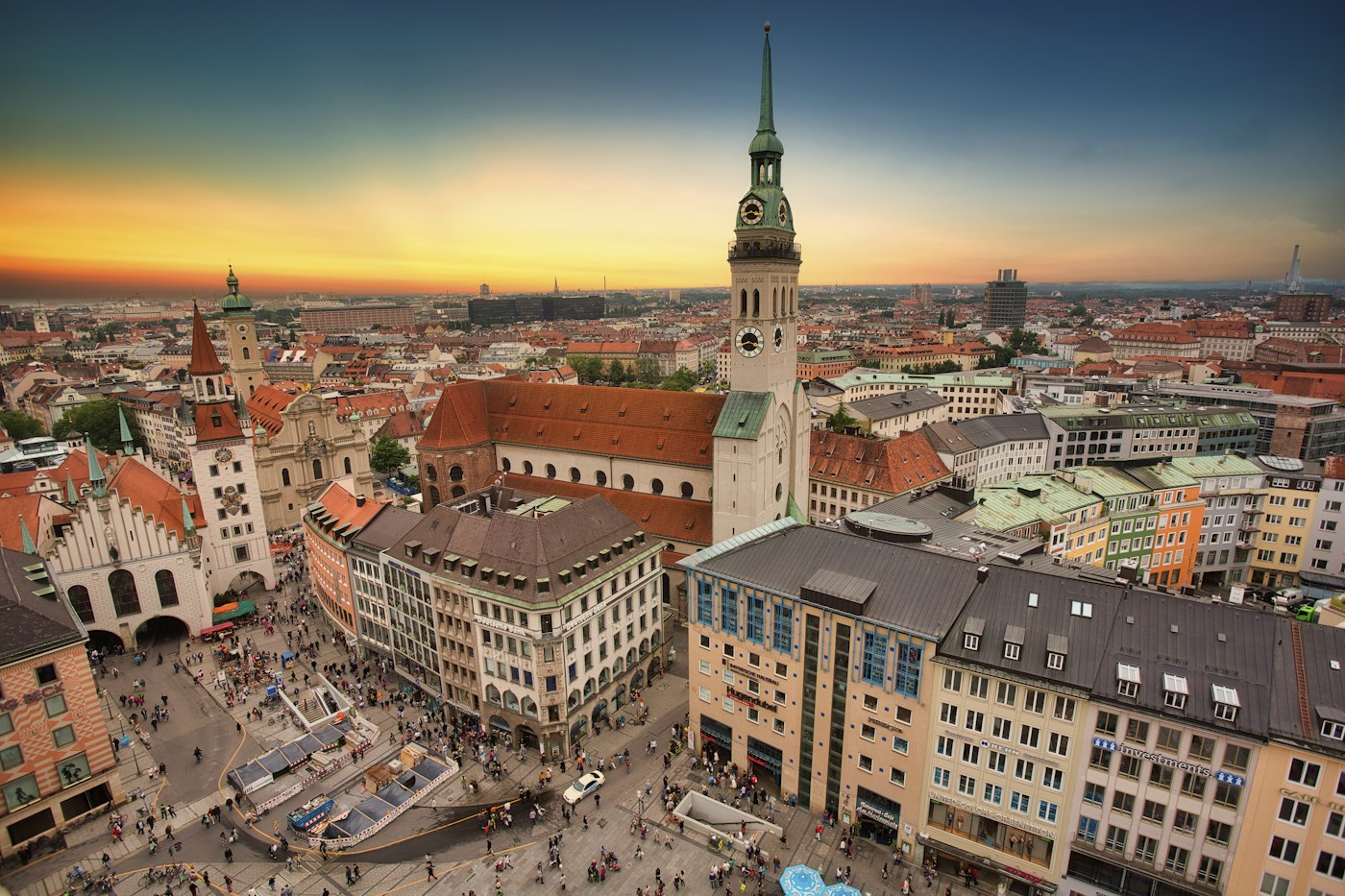
Munich is where German efficiency meets Alpine lifestyle — and where the paycheck usually justifies the price tag. It's the country's wealthiest big city, home to BMW, Siemens, Allianz and a fast-growing tech scene, with lakes and mountains close enough for a Friday-afternoon escape. It's also Germany's most expensive city to rent in, more conservative and more Bavarian-dialect-heavy than Berlin, and slower to warm up to newcomers. This guide gives you the real picture: what things cost, which Stadtteil (district) fits you, and how to build a life here.
1. Why Munich (and why not)
The case for: the highest salaries in Germany, near-full employment, some of the country's best schools and healthcare, spotless public transport, and unmatched access to the Alps, lakes (Starnberger See, Ammersee) and Italy (3-hour drive). Crime is low, parks are excellent (English Garden is bigger than New York's Central Park), and the quality of life consistently ranks Munich among Europe's most livable cities.
The honest counterpoints: rent is the highest in Germany — often 20–30% above Berlin for equivalent space — and the vacancy rate is even tighter. The culture is more traditional and less English-friendly outside of the big corporates; Bavarian identity is strong and dialect is common in everyday speech. Winters are cold with less nightlife energy than Berlin. If budget or an international bubble matters more than salary and scenery, compare with Berlin on the IC360 Community.
2. Neighborhoods: finding your Stadtteil
Munich is compact and well-connected — most Stadtteile are 20–30 minutes from the center by U-Bahn or S-Bahn. Rents below are typical warm-rent ranges for a 1-bedroom on new contracts.
Schwabing
Student & bohemianMunich's historic artist quarter, now home to LMU/TU students and young professionals. Cafés, boutiques and the English Garden on your doorstep.
Maxvorstadt
Museums & academiaThe Kunstareal museum quarter, two major universities, elegant Gründerzeit buildings. Central, walkable, and intellectually alive.
Glockenbachviertel
Trendy & LGBTQ+Munich's most fashionable quarter — indie boutiques, wine bars, the city's LGBTQ+ hub, and the Isar river footsteps away.
Haidhausen
Bavarian charmCobblestone streets, traditional beer gardens (Hofbräukeller), and a big international-family presence near the Gasteig culture center.
Bogenhausen
Upscale & quietVilla-lined streets, consulates and executives. Close to the Arabella business district and the Bogenhausen hospital cluster.
Sendling
Best valueA working-class district turning trendy without losing affordability — good U-Bahn links and the Westpark green space nearby.
Neuhausen-Nymphenburg
Families & palace groundsAnchored by Nymphenburg Palace's gardens, this is Munich's classic family quarter — good schools, playgrounds, and a strong sense of neighborhood.
Giesing
Up-and-comingFormerly working-class, now attracting young professionals and creatives priced out of Glockenbachviertel. Great Isar access.
3. Cost of living: a realistic Munich budget
| Item | Monthly cost | Notes |
|---|---|---|
| Rent (1-bed, warm) | €1,400–2,200 | New contracts; WG room €700–1,000 |
| Health insurance | ~€0 employee share visible | Deducted from payroll (~8.5% of gross) |
| Public transport | €58 | Deutschlandticket — verify current price |
| Groceries | €280–420 | Aldi/Lidl/REWE, single person |
| Phone + internet | €40–60 | SIM €10–20 + home fiber €30–40 |
| Radio tax | €18.36 | Per household, mandatory |
| Beer garden / dining out | €150–350 | Munich prices run above the German average |
| Realistic single total | €2,600–3,300 | Comfortable, offset by higher salaries |
Gross salaries in Munich typically run 10–20% above Berlin: engineers €65,000–100,000+, finance/insurance roles €55,000–85,000, automotive engineering specialists often higher. Model your specific numbers with the tools on our Finance pillar.
4. Finding housing (Germany's tightest market)
Munich's rental vacancy rate is even lower than Berlin's — good listings can receive 50–100+ inquiries within hours. Treat the hunt as a full-time project for your first weeks.
Tactics that actually work
- Prepare a complete application PDF before you search: intro letter with photo, passport copy, last 3 payslips or work contract, SCHUFA report (get one free at meineschufa.de once registered) and proof of no rent debt if you've rented in Germany before.
- Set instant alerts on ImmobilienScout24 and WG-Gesucht — reply within minutes, ideally in German.
- Start with a furnished interim flat (Wunderflats, HousingAnywhere) or WG room to secure your Anmeldung, then hunt the long-term flat from inside the city.
- Relocation agencies are more common here than in Berlin — many employers (especially in automotive/insurance) offer relocation support or agency access as part of the package. Ask HR before you search alone.
- Browse Haus to Haus (IC360) — departing expats hand over flats, kitchens and furniture to arriving ones.
⚠️ Know your rights: the Mietpreisbremse (rent brake) applies in Munich too, but the reference index (Mietspiegel) is Germany's highest — meaning "capped" rents are still steep. Never pay a deposit above 3 cold rents, and never pay before signing a contract and viewing the flat in person or via a trusted video call.
5. Getting around: MVV covers everything
- MVV network — U-Bahn (8 lines), S-Bahn (radiating to the wider region, including the Alps and lakes), trams and buses, all on one integrated ticketing system. The Deutschlandticket (~€58/month) covers all local transport across Germany.
- Bikes — Munich is flat and bike-friendly, especially along the Isar river paths. Used bikes run €150–350 on Kleinanzeigen; theft is common, so use two locks.
- The airport — Munich Airport (MUC) connects via S-Bahn (S1/S8) in about 40 minutes; it's one of Europe's best-rated airports.
- Weekend escapes — regional trains reach Alpine towns (Garmisch-Partenkirchen, Tegernsee) in under an hour, and the lakes (Starnberger See, Ammersee) in 30–40 minutes.
- Driving — more useful here than in Berlin for reaching the mountains and lakes; car-sharing (SHARE NOW, MILES) covers city needs without ownership costs.
6. Healthcare in Munich
Germany's insurance system (public GKV for most, private PKV for high earners and freelancers) applies — Munich's advantage is access and quality:
- Doctolib — filter by "English" to find English-speaking GPs and specialists; supply is good but slightly thinner than Berlin.
- Klinikum der Universität München and Klinikum rechts der Isar — top-tier university hospitals with English-speaking specialist departments.
- Waiting times — GP visits within days; specialist waits (dermatology, psychiatry) can run 4–10 weeks for public patients. The 116117 service can broker faster specialist appointments.
- Mental health — our Psychology pillar lists relocation-specialized, multilingual psychologists you can book directly.
- Pharmacies (Apotheke) — for real medication; emergency pharmacies rotate nightly. Emergencies: 112.
7. Jobs & industry
Munich is Germany's corporate capital: BMW, Siemens, Allianz, Munich Re and MAN are all headquartered here, alongside a growing tech and biotech cluster (Google, Microsoft, Amazon, IBM Research, and a strong life-sciences corridor around Martinsried).
- Where to look: LinkedIn, StepStone, and company career pages — Munich's job market skews toward automotive engineering, insurance/finance and enterprise tech.
- Salary reality: senior engineers €80,000–115,000+, insurance/finance professionals €60,000–95,000, junior roles from ~€48,000. Munich's cost premium is real, but so is the pay premium.
- Freelancing — less common culturally than in Berlin; corporate roles dominate. Coworking spaces (WERK1, Mindspace) exist but the startup scene is smaller.
- Check visa options for your nationality in our route guides (e.g., Brazil→Germany, USA→Germany) and the Work & Career pillar.
8. Language & community
Munich is more German-first than Berlin — fewer English-only workplaces outside the big multinationals, and Bavarian dialect appears even in official contexts. B1 German is required for permanent residency, and daily life is smoother once you have it.
- Volkshochschule München (MVHS) — affordable, structured German courses across all levels.
- Sprachcafés and tandems — regular meetups via Meetup.
- Facebook & expat groups — "Munich Expats", "Toytown Munich"-style communities and nationality-specific groups help with day-to-day questions.
- Sports & hobbies — Vereine (clubs) for football, hiking (Munich's proximity to the Alps makes hiking clubs huge), rowing on the Isar, and beer-garden culture as informal social glue.
- The IC360 Community — meet people moving to Munich on your exact route, ask questions before you land.
9. Kitas & schools
- Kita (0–6) — public Kita spots are in high demand; apply as early as pregnancy confirmation via your district's Kita-Finder portal. Fees are income-based and modest compared to private daycare abroad.
- State schools — free, high academic standards (Bavaria consistently ranks among Germany's top states for education), assigned by catchment for Grundschule (ages 6–10).
- International schools — Munich International School (IB, in Starnberg), Bavarian International School — private, €15,000–25,000/year, popular with relocating corporate families.
- Bilingual programs — some public and semi-private bilingual (German-English) Kitas and primary schools exist, though supply is more limited than Berlin's SESB network.
- Homeschooling is illegal in Germany — school attendance is compulsory and enforced from age 6.
10. Culture & daily life: Munich specifics
Oktoberfest defines the calendar
Late September–early October, the whole city shifts gears — locals wear Lederhosen and Dirndl without irony, and tents require early reservations or an early-morning queue.
Sundays are closed
Supermarkets shut, and Munich takes Ruhezeit (quiet hours) more seriously than Berlin — mowing the lawn or running a washing machine loudly on Sunday can draw complaints.
The English Garden is a lifestyle
Bigger than Central Park, with a surfable standing wave (Eisbach), beer gardens, and naked sunbathing zones that surprise newcomers — all completely normal here.
More formal than Berlin
Dress and workplace etiquette run more conservative; titles and formal "Sie" address persist longer in professional settings than in Berlin's startup culture.
Weekend mountain culture
Hiking, skiing and lake swimming are default weekend activities, not special trips — expect colleagues to disappear to the Alps most sunny weekends.
Cash still matters
Card acceptance is improving, but beer gardens, bakeries and markets often prefer cash. Keep €50 on you.
11. Essential Munich apps
Live U-Bahn/S-Bahn/tram routing and Deutschlandticket integration across the whole Munich region.
↗ mvv-muenchen.deBook English-speaking doctors and dentists across Munich without a German phone call.
↗ doctolib.deUsed bikes, furniture and flat leads — essential for furnishing on arrival.
↗ kleinanzeigen.deTranslate official letters, rental contracts and Bavarian bureaucratic German instantly.
↗ deepl.comRoute-plan hikes and bike rides into the Alps and lake region — a Munich-life essential.
↗ komoot.comMid-market currency exchange for moving your savings into euros — pair it with rate alerts on the IC360 Finance pillar.
↗ wise.comReady to make Munich home?
Create your free IC360 account to get a personalised relocation plan, live FX alerts, your interactive Germany checklist and access to the Munich expat community — all in one place.
Free forever · No credit card · Takes 2 minutes