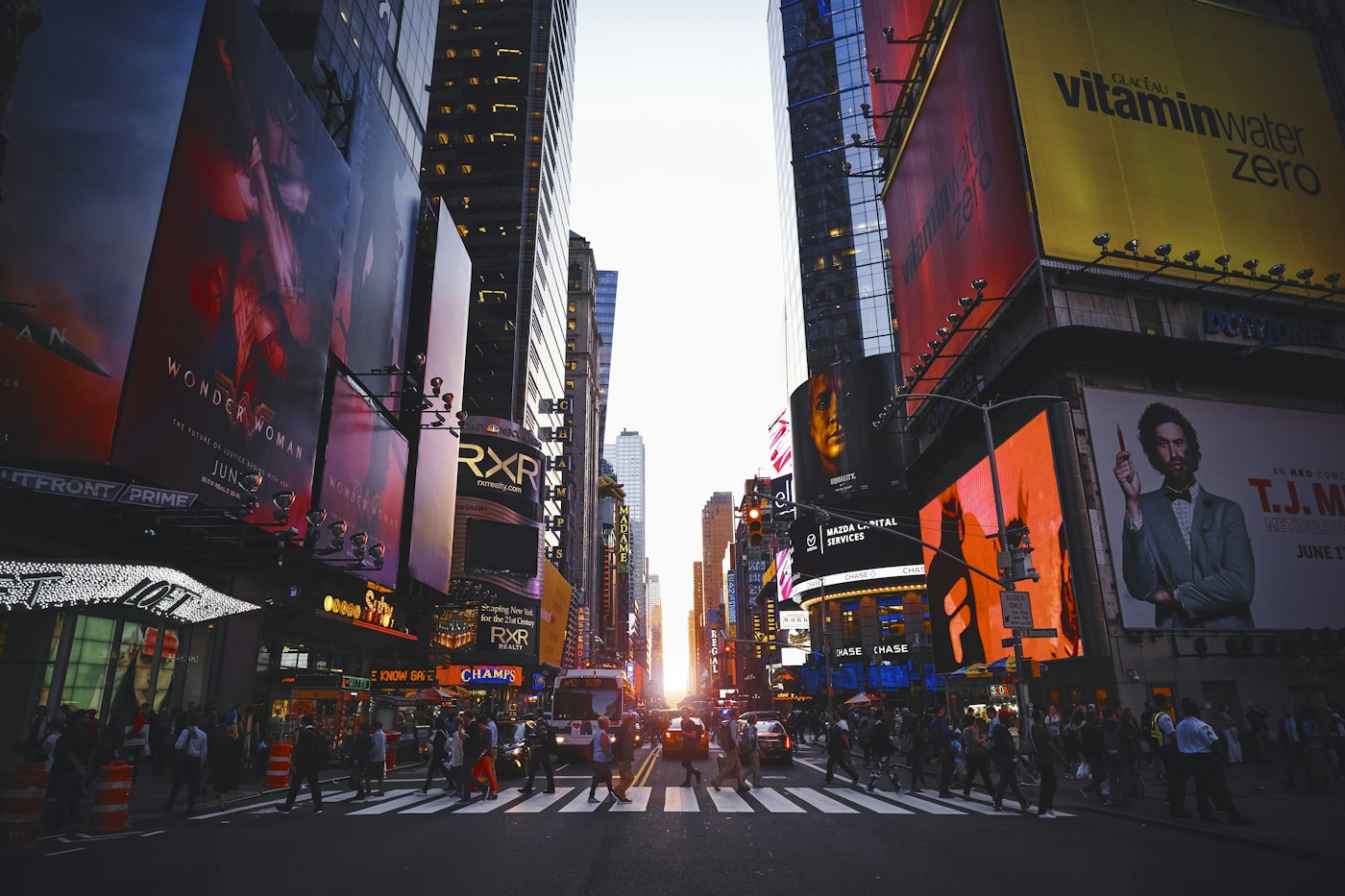
New York City needs little introduction: five boroughs, over 8 million residents, and a genuine claim to being the world's financial and cultural capital. For newcomers it is also uniquely demanding — there is no national public healthcare system, rent-stabilized apartments coexist with market-rate units that can cost double for the same square footage, and the sheer size of the city means "New York" means something completely different depending on which borough and neighborhood you land in. This guide covers what things actually cost in 2026, how the boroughs compare, and the practical sequence — SSN, banking, health insurance, MetroCard/OMNY — that gets you functioning in your first weeks.
1. Why New York (and why not)
The case for: unmatched job density in finance, technology, media, fashion, law and the arts; a 24-hour subway system that makes a car genuinely unnecessary; and arguably the most linguistically and culturally diverse city on the planet — over 800 languages are spoken across the five boroughs. Whatever your background, there is an established community, from Brazilian pockets in Astoria and Newark, NJ, to entire neighborhoods shaped by generations of immigration.
The honest counterpoints: rent is among the highest in the world, and unlike almost every country IC360 covers, there is no universal public health insurance — coverage is employer-based or purchased individually on the ACA Marketplace, and a serious illness without insurance can be financially catastrophic. City and state income tax stack on top of federal tax, one of the highest combined tax burdens in the US. If those trade-offs feel steep, compare NYC against Toronto, which pairs a similar global-city job market with universal healthcare, on the IC360 Community.
2. Boroughs & neighborhoods
NYC is composed of five boroughs, each effectively its own city. Rents below are typical for a 1-bedroom apartment on a new lease, unfurnished.
Williamsburg, Brooklyn
Creative & young professionalWaterfront views of Manhattan, a dense bar and gallery scene, and one of the city's most concentrated 20s-and-30s populations.
Astoria, Queens
Diverse & valueGreek, Brazilian and Middle Eastern communities long-established here, tree-lined streets, and noticeably better value than Manhattan or Williamsburg.
Upper East / West Side, Manhattan
Family & establishedCentral Park at your doorstep, top-rated public and private schools, and a settled, professional demographic favored by relocating families.
East Village / Lower East Side
Young professionalDense nightlife, walk-up apartments, and the classic "starting out in New York" neighborhood for many newcomers in their 20s.
Park Slope, Brooklyn
Family & brownstoneTree-lined brownstone blocks, Prospect Park, and one of Brooklyn's most sought-after areas for families relocating with children.
Jersey City / Hoboken, NJ
Best value + Manhattan accessTechnically New Jersey, but the PATH train puts Manhattan 10–20 minutes away — noticeably lower rent and newer buildings for the money.
3. Cost of living: a realistic NYC budget
| Item | Monthly cost (USD) | Notes |
|---|---|---|
| Rent (1-bed, Manhattan/prime Brooklyn) | $3,200–5,000 | Outer boroughs (Queens, further Brooklyn) 20–35% cheaper |
| MetroCard/OMNY unlimited | $132 | Or pay-per-ride with weekly fare cap |
| Groceries | $400–600 | Trader Joe's/Whole Foods run above national average |
| Health insurance (individual, if not employer-covered) | $400–700+ | ACA Marketplace plans vary widely by deductible |
| Phone + internet | $130–170 | Higher than most of Europe |
| Renter's insurance | $15–25 | Often required by landlords/buildings |
| Eating out / social life | $300–500 | Tipping (18–25%) is mandatory social practice |
| Realistic single total | $4,500–6,500 | Before federal + NY state + NYC income tax |
NYC salaries run well above the US national average to compensate: finance/law $80,000–200,000+, tech $90,000–180,000, media/creative/nonprofit often $50,000–80,000 — noticeably tighter against the cost of living. Model your after-tax budget, including NYC's combined tax burden, on our Finance pillar.
4. Finding housing (especially from abroad)
NYC apartment hunting is fast-paced and document-heavy. Landlords and brokers typically require proof of income equal to 40x the monthly rent annually, or a guarantor earning 80x the rent, plus a credit check — all difficult without US credit history.
Tactics that actually work
- Budget for broker fees — many listings charge a broker fee of 12–15% of annual rent, paid by the tenant; "no-fee" listings exist but move fast.
- Use a guarantor service (Insurent, TheGuarantors, Rhino) if you lack US income history or a US-based co-signer — this unlocks most listings that would otherwise reject international applicants.
- Prepare your file in advance: passport/visa, employment offer letter, 2–3 recent pay stubs or an employer letter confirming salary, and bank statements.
- Search on StreetEasy, Zillow and Apartments.com — StreetEasy is the dominant local platform with the most accurate, up-to-date NYC listings.
- Understand rent stabilization: older buildings (pre-1974, certain later ones) may be rent-stabilized, capping annual increases — ask directly, as this materially affects long-term affordability.
⚠️ Never wire a deposit before an in-person or verified video viewing. Fake listings advertising below-market rent are a common scam targeting newcomers searching from abroad — verify the broker's license via the NY Department of State before sending any money.
5. Getting around: subway, buses and beyond
- OMNY — tap-to-pay with a contactless card or phone has largely replaced the physical MetroCard on subway and buses; weekly fare caps apply automatically.
- The subway — runs 24/7, covering all boroughs except most of Staten Island; extensive but can be unreliable on weekends due to maintenance work.
- Buses — useful for cross-town routes the subway doesn't cover well, especially in Brooklyn and Queens.
- PATH train — connects Manhattan to Hoboken and Jersey City, a common commute for those choosing New Jersey for lower rent.
- Citi Bike — extensive bike-share network, popular for short trips in Manhattan and inner Brooklyn.
- Car ownership — rare and impractical in Manhattan; more common (but still optional) in outer Queens, Staten Island and NJ suburbs.
- Airports — JFK (AirTrain + subway, ~60–75 min from Manhattan), LaGuardia (bus/subway combo), Newark (NJ Transit/AirTrain).
6. Healthcare: no public system
The US has no universal public healthcare system — this is the single biggest structural difference newcomers from Europe, Canada or Brazil's SUS need to plan for.
- Employer-provided insurance — most full-time jobs include health insurance; understand your plan's deductible, copay and network before you need care.
- ACA Marketplace — if self-employed or between jobs, individual plans are available via healthcare.gov or NY State of Health, with subsidies based on income.
- Never go uninsured — a single ER visit or hospital stay without insurance can run into tens of thousands of dollars; this is not an area to under-budget.
- Urgent care clinics — for non-emergency issues, urgent care (e.g. CityMD) is faster and cheaper than an ER visit.
- Mental health — our Psychology pillar connects you with relocation-specialized, Portuguese and Spanish-speaking psychologists who understand the specific stress of navigating US healthcare as a newcomer.
- Emergencies — dial 911.
7. Jobs & industry
New York is the undisputed center of global finance (Wall Street, Midtown) and has grown into a major tech hub ("Silicon Alley") alongside its historic strength in media, fashion, law and the arts.
- Where to look: LinkedIn, eFinancialCareers (finance), Built In NYC (tech), and direct company career pages.
- Salary reality: finance/law $80,000–200,000+, tech $90,000–180,000, media/nonprofit typically $50,000–80,000 — factor cost of living heavily into any offer.
- Social Security Number (SSN) — required to be paid legally; apply at a Social Security Administration office as soon as your visa status permits.
- Work visas — H-1B (specialty occupation, lottery-based), L-1 (intracompany transfer), O-1 (extraordinary ability) are the most common routes; check our Brazil→USA route guide for the full breakdown.
- Also see the Work & Career pillar for visa rights and CV format guidance.
8. Language & community
English dominates, but NYC is arguably the most linguistically diverse city on earth — over 800 languages are spoken, and neighborhoods retain distinct identities shaped by generations of immigration.
- Brazilian community — historically centered on "Little Brazil" (46th Street, Manhattan) with a larger residential presence in Astoria, Queens, and across the river in Newark, NJ.
- Diaspora density — from Chinatown to Jackson Heights (one of the most linguistically diverse neighborhoods in the world) to Brighton Beach's Russian community, established networks exist for nearly every nationality.
- Fast-paced social norms — directness and efficiency are the default; this isn't rudeness, it's local pace, especially in Manhattan.
- Meetup and professional networking — extremely active across every industry and nationality group.
- The IC360 Community — connect with others moving to NYC on your exact route before you land.
9. Schools & education
- Public schools — free through the NYC Department of Education, the largest school district in the US; enrollment is zoned by address, with competitive specialized and gifted programs.
- Private schools — a long NYC tradition, $40,000–65,000+/year at top independent schools, often with waitlists requiring early application.
- International schools — the Lycée Français de New York, various German, Japanese and other national-curriculum schools serve relocating families wanting continuity.
- Childcare — among the most expensive in the US; full-time infant daycare in Manhattan can run $2,500–4,000+/month — budget for this early and apply to waitlists as soon as possible.
10. Culture & daily life: NYC specifics
Tipping is not optional
18–25% at restaurants, plus tips for delivery, hairdressers and taxis — many service workers rely on tips as a substantial part of their income; skipping it is a real social breach.
Fast pace is the default
Walking speed, ordering speed, conversation directness — all faster than most cities. It's efficiency, not rudeness, though it takes adjustment.
Your borough is part of your identity
"Manhattan vs. the boroughs" carries real social and cultural weight — expect people to have strong opinions about where you live.
Delivery culture is extreme
Nearly anything — food, groceries, alcohol — arrives in 15–30 minutes via app; it's genuinely built into daily routines, not a luxury.
Culture is everywhere, at every price point
World-class museums, Broadway, and free outdoor summer concerts and festivals across every borough — the cultural density offsets some of the cost pressure.
Sales tax isn't in the sticker price
NYC's combined sales tax (~8.875%) is added at checkout, not shown on the shelf price — budget mentally for the markup on every purchase.
11. Essential NYC apps
Real-time subway and bus arrivals, service alerts and route planning across all five boroughs.
↗ mta.infoThe default peer-to-peer payment apps for splitting rent, dinners and everyday transfers — used constantly.
↗ venmo.comBook doctor appointments filtered by insurance accepted — essential for navigating the US healthcare system as a newcomer.
↗ zocdoc.comNYC's dominant apartment-hunting platform — filter by no-fee listings, and set alerts for fast-moving inventory.
↗ streeteasy.comMid-market currency exchange for moving savings into USD — pair it with FX rate alerts on the IC360 Finance pillar.
↗ wise.comReady to make New York home?
Create your free IC360 account to get a personalised relocation plan, live FX alerts, your interactive USA checklist and access to the NYC expat community — all in one place.
Free forever · No credit card · Takes 2 minutes