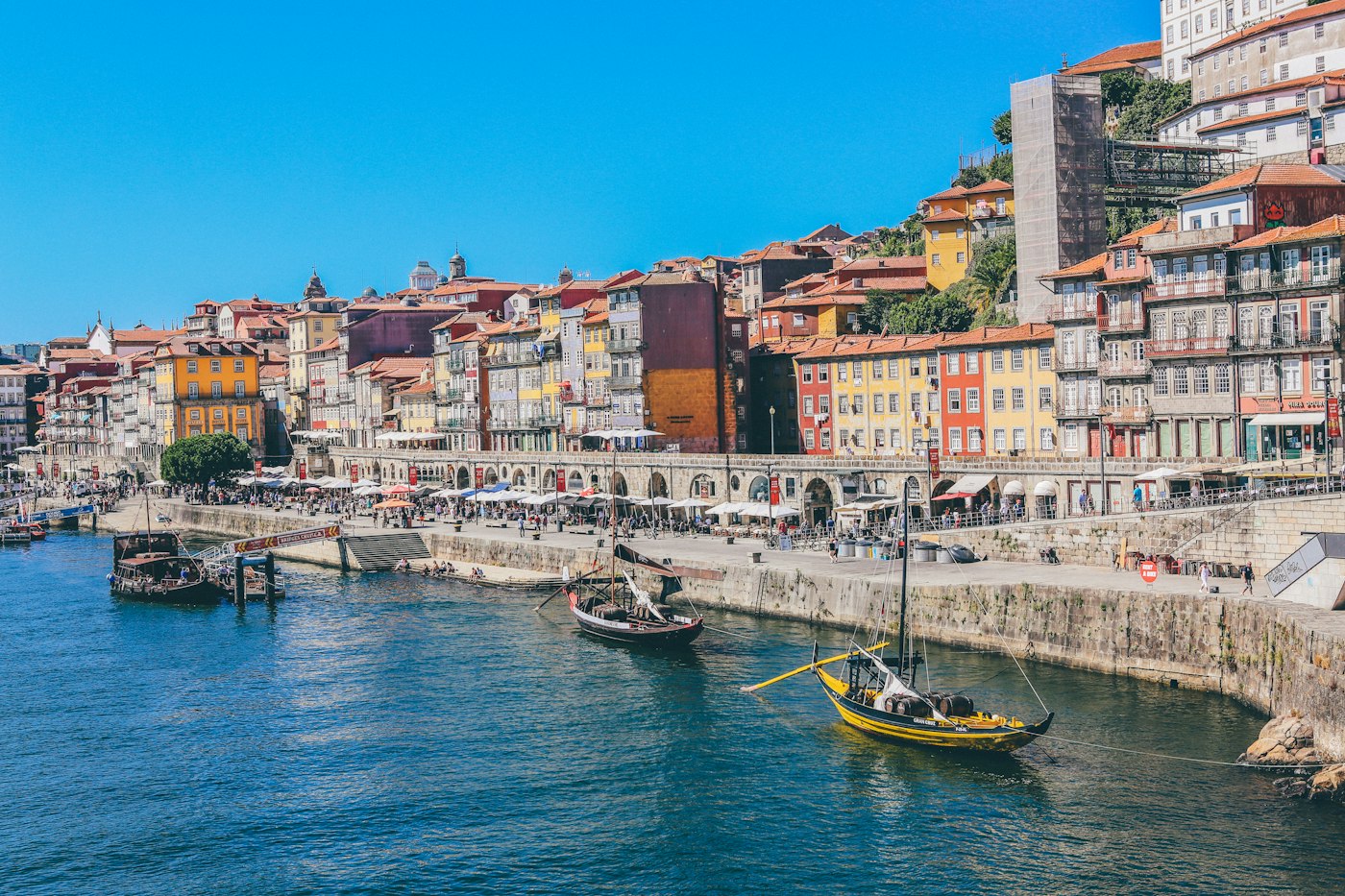
Portugal is the second-biggest corridor for IC360 movers — and the questions repeat: How do I get a NIF from abroad? Is the D7 still viable? What happened to NHR? Why is everyone complaining about AIMA appointments? Here are the 25 most common questions, answered clearly. For the full step-by-step walkthrough, see the IC360 Portugal Country Path.
Visas & Residence
Do I need a visa to move to Portugal?
EU/EEA/Swiss citizens: no visa, just a residence certificate after 90 days. Brazilians, Americans, Brits, Canadians and others enter visa-free for 90 days as tourists — but living and working requires a residence visa or permit. Brazilians and other CPLP nationals have the simplified CPLP route (next question). Everyone else applies for a D-type national visa at a Portuguese consulate first. Official portal: aima.gov.pt.
What is the CPLP residence permit for Brazilians?
Under the CPLP mobility agreement (in force since 2022), citizens of Portuguese-speaking countries — Brazil included — can obtain a simplified residence permit with reduced requirements and fees, in many cases even after entering as a tourist. It has been the fastest legal route for Brazilians, but rules, document lists and processing have changed repeatedly since launch — verify the current procedure at AIMA before building your plan on it.
What is the D7 visa and how much income do I need?
The D7 is the passive-income visa — ideal for retirees and anyone living on pensions, rental income or dividends. The threshold tracks the Portuguese minimum wage (roughly €870–920/month for the main applicant in 2026; +50% per adult dependant, +30% per child), plus proof of accommodation and a clean record. Full process from Brazil in our D7 visa guide.
Does Portugal have a digital nomad visa?
Yes — the D8, for remote workers with foreign employers or clients. Income requirement: four times the minimum wage (roughly €3,500–3,700/month in 2026), shown with payslips or contracts from the last months. Two flavours: temporary stay (up to 12 months) or a residence version that leads to a renewable permit and counts toward citizenship. Entrepreneurs building a business in Portugal should look at the D2 instead.
Can I bring my spouse and children?
Yes. Family reunification covers spouses, minor children and dependent parents, and families can often apply together. CPLP nationals get simplified treatment. Children enter free public school immediately regardless of paperwork status, and Brazilian school records are recognised through a standard equivalence process.
How do I get permanent residence or citizenship?
Under current law: 5 years of legal residence qualifies you for both permanent residence and citizenship, with A2 Portuguese (automatic pass for Brazilians via CIPLE or school history). Portugal allows dual citizenship — you keep your original passport. Important: nationality-law reforms extending the timeline have been under political discussion, so verify the rules in force when you apply. Track your milestones with the IC360 visa tracker.
What is the Estatuto de Igualdade (Equality Statute)?
A Brazil-only privilege from the 2000 Porto Seguro treaty: after getting Portuguese residence, Brazilians can request the Equality Statute online via the Justice Ministry, gaining near-equal civil rights with Portuguese citizens (and optionally political rights, including voting) — all without touching your Brazilian citizenship. It's cheap, fast and criminally underused. Details in the Portugal Country Path.
NIF, AIMA & Bureaucracy
What is the NIF and why do I need it before anything else?
The NIF (tax number) is the master key of Portuguese life: no NIF, no bank account, no lease, no phone contract, no salary. Get it at any Finanças office in person, or remotely from Brazil through a fiscal representative or online NIF services — many movers arrive with it already in hand, which accelerates everything else by weeks.
What is AIMA and why does everyone complain about it?
AIMA replaced the old SEF in October 2023 as the immigration agency handling residence permits and renewals. It inherited a massive backlog, and appointment scarcity is the #1 frustration of new arrivals — worse than any single visa requirement. Survival rules: book the earliest slot you can get (even months out), keep dated proof of every submission and email, and check aima.gov.pt for procedure changes before appointments.
What is the NISS and when do I need it?
Your social security number — required to work legally, contribute and access benefits. Employees: usually arranged by the employer. Freelancers and everyone else: request online via Segurança Social Direta with passport, NIF and proof of address. Freelancers get a first-year contribution exemption — use it to stabilise cash flow.
What proof of address do Portuguese institutions accept?
Either your registered rental contract or an atestado de morada issued by the local Junta de Freguesia (parish office) — typically requiring your ID, NIF and either a declaration or two witnesses, depending on the parish. You'll use it for the health centre, banking, IMT licence exchange and AIMA. Unregistered leases can't produce it — one more reason to insist on a registered contract.
Housing
How hard is it to rent in Lisbon or Porto?
Expensive relative to local salaries and competitive in the centre. Typical 1-bedroom: Lisbon €1,100–1,600, Porto €850–1,300; Braga, Coimbra, Évora and the interior run far cheaper. Landlords ask for 2–3 months upfront and proof of income; without a Portuguese fiador (guarantor), offering extra months in advance is the standard workaround. Full strategy in the IC360 Home & Living pillar.
Where do I search for housing?
Idealista (biggest), Imovirtual, Casa Sapo and OLX; for furnished first-months rentals, Uniplaces and HousingAnywhere. Facebook housing groups are very active but scam-prone: never pay before a live viewing (in person or video call showing the actual flat), and treat "landlord abroad, send deposit" as an automatic red flag.
What should my rental contract include?
A written arrendamento contract with your NIF, registered by the landlord with Finanças. The registered contract is your proof of address for AIMA, banking and the SNS — and your legal protection on deposits and notice periods. If a landlord resists registration ("to avoid taxes"), walk away: it blocks your entire paperwork chain.
Healthcare (SNS)
How does the SNS work for immigrants?
Portugal's national health service covers legal residents with no waiting period — a major contrast to Canada or Germany. Register at your local centro de saúde with residence document, NIF and proof of address to get your número de utente. Primary-care user fees have been largely abolished. Emergencies: 112. Medical advice line: SNS 24 — 808 24 24 24.
Do I also need private health insurance?
Visa applications usually require initial coverage, and many residents keep private insurance (~€30–80/month) to skip SNS specialist waiting lists — the system's weak spot. Médis and Multicare are the big names. Think of it as a comfort upgrade on top of the SNS, not a replacement.
Money, Banking & Taxes
Can I open a bank account before arriving?
With a NIF in hand, yes — ActivoBank and Millennium BCP support remote opening, and Wise/Revolut serve as instant bridge accounts. In-branch you'll need NIF, passport and proof of address. A Portuguese account (or at least a Portuguese-IBAN-friendly one) matters for salary, rent and utility direct debits. Money transfers Brazil↔Portugal: compare Wise, Remessa Online and Nomad in our transfer guide and set FX alerts in the Finance pillar.
What happened to the NHR tax regime?
The famous NHR closed to new applicants at the end of 2023. Its successor IFICI ("NHR 2.0") offers a 20% flat rate — but only for defined research, innovation and highly-qualified professions. Anyone marketing "NHR benefits" in 2026 deserves scrutiny. Cross-border tax (Brazil–Portugal treaty, IRS brackets, freelancer regime) is worth one session with a Portuguese accountant — find vetted specialists via the Finance pillar.
How high are taxes in Portugal?
IRS runs progressively from ~13% to 48%, plus 11% employee social security. Freelancers contribute quarterly (after a first-year exemption) and most use the simplified regime, where only part of revenue is taxed. Residents are taxed on worldwide income; the Brazil–Portugal double taxation treaty prevents most double charging if you declare correctly in both countries. Details: IC360 Finance pillar.
How much do I need to live comfortably?
Single person, all-in monthly: Lisbon ~€1,300–1,800, Porto ~€1,100–1,500, smaller cities ~€900–1,300 — rent is the swing factor. Groceries, transport (Lisbon's Navegante pass ~€40) and restaurants stay affordable by Western European standards. The flip side: local salaries are low (minimum ~€870–920, average net ~€1,100–1,400), which is why remote foreign income goes so far here.
Work & Driving
Is it easy to find a job in Portugal?
Demand is real in tech (Lisbon/Porto hubs), tourism and hospitality, multilingual customer support (constant hiring, often no Portuguese required), healthcare and construction — but salaries are well below northern Europe. Boards: LinkedIn, Net-Empregos, Sapo Emprego, Landing.jobs (tech). Many movers instead keep remote foreign income on a D8 — legally cleaner and financially smarter. CV formats and strategy: Work & Career pillar.
Can I use my Brazilian driving licence?
Yes — Brazil–Portugal mutual recognition means your valid Brazilian licence exchanges for a Portuguese one at the IMT with no exams, just paperwork and a medical certificate. Start the exchange promptly after residence (the window for driving on the foreign licence is limited — verify current IMT deadlines). EU licences need no exchange at all.
Language & Daily Life
Is European Portuguese hard for Brazilians?
You'll communicate from day one, but the ear needs 2–4 weeks: closed vowels, swallowed syllables and speed make European Portuguese harder to parse than expected. Vocabulary flips too — autocarro/ônibus, telemóvel/celular, pequeno-almoço/café da manhã — and treatment forms are more formal. Embrace it as an accent upgrade, not a barrier. Non-lusophone movers need A2 for citizenship; courses and tools in the Language pillar.
Is Portugal really that safe?
Consistently top-10 in the Global Peace Index. Violent crime is rare; watch for pickpockets on tram 28 and in tourist zones, and that's roughly the extent of it. For movers from Brazil especially, the freedom to walk anywhere at any hour — phone in hand — is repeatedly described as the single most life-changing aspect of the move. The psychological adjustment is real: our adjustment timeline covers it.
What is MB Way and how do payments work?
MB Way is Portugal's universal mobile payment app: instant transfers by phone number, online payments, and cardless ATM withdrawals — all linked to your bank via the Multibanco network. Multibanco ATMs also pay utility bills, taxes and phone top-ups. Cards work nearly everywhere; keep a few euros in cash for small cafés and markets.
What should I do in my first two weeks?
In order: (1) NIF, if not obtained from abroad; (2) Portuguese SIM — MEO, Vodafone or NOS; (3) bank account; (4) registered lease or atestado de morada; (5) NISS if working; (6) book any AIMA appointment immediately — scarcest resource in the country; (7) register at the centro de saúde for your número de utente. The Portugal Country Path has the full sequence, and the pre-departure checklist covers what to do before flying.
Got your answer? Now get your plan.
Create your free IC360 account for a personalised Portugal relocation checklist, live BRL/EUR alerts, visa tracking, and a community of people moving on your exact route.
Free forever · No credit card · Takes 2 minutes